

When it comes to starting a construction project, choosing the right general construction contractor is a critical decision that can influence the success of your project. Whether you are working on a multi-family construction development, a single-family home build, or a commercial construction project, the expertise and reliability of your contractor are essential. A well-established contractor will not only help you navigate the complex aspects of the construction process but also ensure that your project stays on schedule and within budget.
At Regency General Contractors, we bring over 35 years of experience to the table, specializing in a wide range of projects, including multi-family construction, single-family housing, and commercial construction. Our reputation is built on innovation, reliability, and integrity, and we take pride in offering tailored solutions for each of our clients.
In this blog post, we will answer common questions about general construction contractors, the different types of contractors you may encounter, and the various construction contracts that are critical to understanding the construction process. Whether you’re a first-time builder or an experienced developer, this guide will provide valuable insights to help you make informed decisions for your next project.
What Is a General Construction Contract?
A general construction contract is a legally binding agreement between a client and a contractor, outlining the scope, timeline, budget, and responsibilities for a construction project. The contract sets the terms for how the work will be completed and ensures that both parties are clear about their obligations throughout the project.
For general contractors, their role is to manage the overall project from start to finish, making sure that the work is carried out as planned, within the agreed timeline, and on budget. This means they coordinate all aspects of the project, from hiring and managing subcontractors to purchasing materials, overseeing inspections, and ensuring compliance with local regulations.
The structure of a general construction contract typically includes the following:
- Scope of Work: This outlines the specific tasks that the contractor will handle, which may vary depending on whether the project is multi-family construction, single-family construction, or commercial construction. The scope also defines the expectations for the finished product.
- Project Timeline: This provides a detailed schedule that outlines project milestones, deadlines, and completion dates. Timely delivery is especially crucial for commercial construction, where delays can result in significant financial consequences.
- Cost and Payment Terms: The contract will break down the total project cost, including labor, materials, and other expenses. The payment schedule is also defined, which may involve an upfront deposit followed by progress payments.
- Liabilities and Responsibilities: The contract specifies who is responsible for what, including materials, permits, and any unforeseen challenges. This section ensures that each party knows their duties and helps avoid disputes as the project progresses.
- Dispute Resolution: In case of any disagreements or challenges, the contract typically outlines procedures for resolving issues without escalating them to court.
In the context of multi-family construction, single-family housing, or commercial construction, a well-defined general construction contract is critical for ensuring that the project proceeds smoothly and meets both the client’s expectations and industry standards. Whether you’re building a new single-family home or a large-scale commercial construction project, the contract protects both the client and the contractor, providing clarity and peace of mind throughout the construction process.
What Are the Three Types of Construction Contractors?
In the construction industry, contractors are typically classified into three main types based on the scope of their work and the level of responsibility they assume on a project. These are general contractors, specialty contractors, and subcontractors. Each plays a vital role in completing a construction project, whether it’s multi-family construction, single-family construction, or commercial construction. Let’s explore these contractor types in detail:
1. General Contractors
A general contractor (GC) is the primary contractor responsible for overseeing an entire construction project. They serve as the project manager, coordinating the various elements of the construction process, managing timelines, ensuring that work is completed to code, and keeping the project within budget.
Key responsibilities of a general contractor include:
- Hiring and managing specialty contractors and subcontractors.
- Securing building permits and ensuring the project complies with local regulations.
- Overseeing the day-to-day construction activities, including ordering materials and scheduling inspections.
- Ensuring safety protocols are followed on the construction site.
- Handling any issues or delays that may arise throughout the course of the project.
In the case of commercial construction, multi-family construction, or single-family construction, the general contractor is the point of contact for the client, handling all logistical and managerial aspects of the build.
2. Specialty Contractors
Specialty contractors focus on specific trades or aspects of a construction project. Unlike the general contractor, who manages the whole project, specialty contractors provide specialized skills in areas such as electrical work, plumbing, HVAC (heating, ventilation, and air conditioning), roofing, or concrete work.
Some common examples of specialty contractors include:
- Electricians: Handling electrical systems for the project.
- Plumbers: Installing plumbing systems.
- HVAC Specialists: Installing and maintaining heating, ventilation, and air conditioning systems.
- Roofing Contractors: Installing or repairing roofs.
In multi-family construction, commercial construction, or single-family housing, specialty contractors are hired by the general contractor to handle these specific aspects of the project that require expertise and certification.
3. Subcontractors
A subcontractor is hired by the general contractor (or sometimes by specialty contractors) to perform specific tasks within the larger construction project. These are often specialized roles, such as laying the foundation, pouring concrete, or installing drywall.
Subcontractors are typically responsible for the more detailed, labor-intensive tasks that require specialized knowledge or equipment.
In a multi-family construction or commercial construction project, a subcontractor could be responsible for:
- Concrete work: Pouring and setting the foundation.
- Masonry: Installing bricks, stone, or other masonry materials.
- Landscaping: Preparing outdoor areas for landscaping, including planting trees, laying sod, or installing irrigation systems.
Subcontractors report to the general contractor and are expected to complete their tasks within the specified time frame and according to the agreed-upon quality standards.
Understanding the roles of general contractors, specialty contractors, and subcontractors is essential when planning your construction project, whether it’s a single-family home, multi-family housing, or commercial development. A well-managed project requires the right balance of expertise from each contractor type to ensure the work is done efficiently, on time, and within budget.
What Is the Difference Between Main Contractor and General Contractor?
In the construction industry, the terms main contractor and general contractor are often used interchangeably, but there are subtle differences between the two. Understanding these differences can help clarify the responsibilities and scope of work when you’re embarking on a multi-family construction, single-family construction, or commercial construction project.
General Contractor
A general contractor (GC) is responsible for the overall management of the construction project. They serve as the point of contact for the client and oversee the entire project from start to finish. This includes:
- Project Management: The general contractor manages the schedule, resources, and workforce.
- Hiring Subcontractors: The GC hires specialty contractors and subcontractors to handle specific tasks such as electrical, plumbing, and landscaping.
- Coordination: The GC coordinates the flow of the project, ensuring that all phases of construction happen in a timely manner and according to specifications.
- Budget and Payment: The GC is responsible for managing the project’s budget, including paying subcontractors and ensuring that the project stays within financial constraints.
- Compliance and Permits: They ensure that the construction meets all legal requirements and building codes, including obtaining necessary permits and arranging inspections.
In short, the general contractor is in charge of the entire project and is accountable for ensuring everything runs smoothly.
Main Contractor
The term main contractor is often used in a more specific context to refer to the contractor in charge of a significant portion of the project or the principal contractor overseeing a particular part of the job. The main contractor may or may not have the same level of responsibility as the general contractor, but here are the key points that distinguish them:
- Specialized Focus: A main contractor typically manages one specific element of the construction project, such as site preparation, the foundation, or structural work. In contrast, the general contractor oversees the entire project.
- Scope of Work: The main contractor’s scope of work is typically more narrowly defined compared to the general contractor, who handles a broader range of activities across all areas of construction.
- Limited Responsibility: While a general contractor is responsible for the overall completion of the project, a main contractor has limited authority and may focus on completing just one part of the work. They report directly to the general contractor.
Key Differences
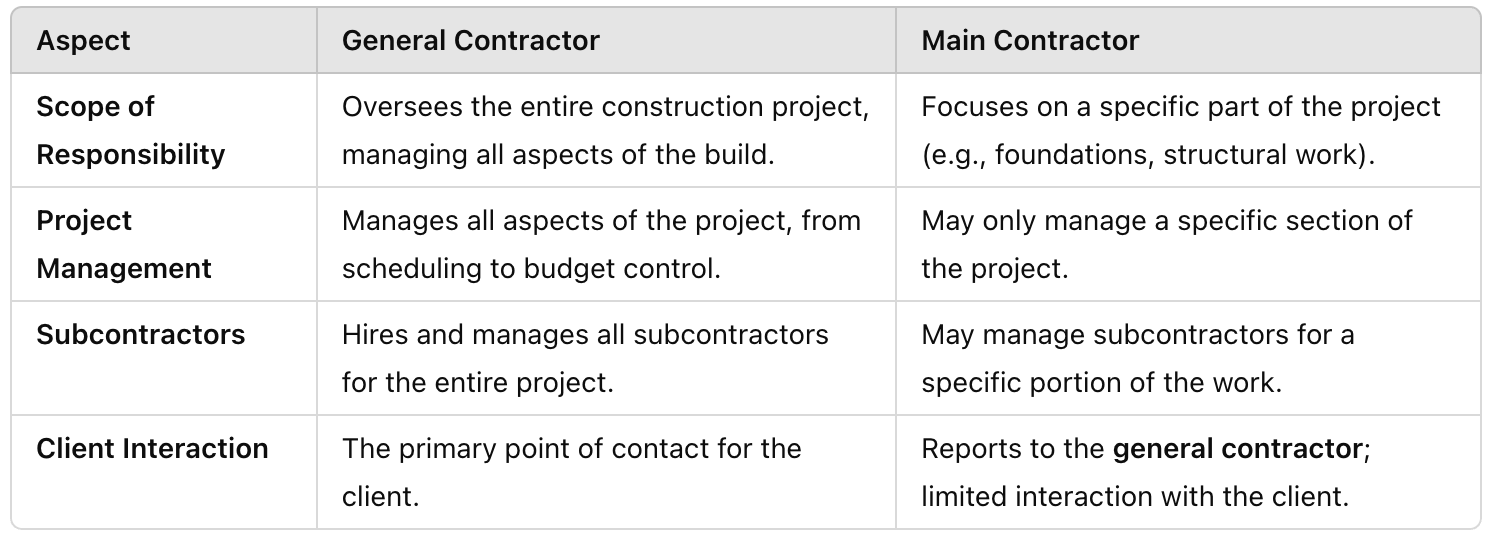
Main Contractor vs. General Contractor in Construction Projects
When it comes to projects like multi-family construction, single-family housing, or commercial construction, a general contractor usually takes on the responsibility of overseeing the project’s completion. However, in larger and more complex projects, there may be a main contractor for certain segments, such as foundation work or structural elements.
In any case, the general contractor remains the primary individual responsible for the successful delivery of the project, ensuring that everything is completed according to the plan, on time, and within budget.
Understanding the differences between the main contractor and the general contractor can help you better navigate the construction process and make informed decisions about who to hire for various responsibilities on your construction project.
What Are the Types of Contractors According to PCAB?
The Philippine Contractors Accreditation Board (PCAB) categorizes contractors into different classifications based on the type of work they specialize in and their capabilities. Understanding these classifications is important for anyone embarking on a construction project, whether it’s multi-family construction, single-family housing, or commercial construction. The PCAB provides a framework for determining the appropriate contractors for specific projects based on their skills, experience, and licensing.
1. General Contractors (GE)
General Contractors (GE) are typically involved in large-scale projects and oversee the entire construction process. These contractors manage everything from the initial planning stages to project completion. Their duties include coordinating work, hiring subcontractors, managing schedules, and ensuring that all work meets building codes and regulations.
GE contractors are the most common type for commercial construction and multi-family housing projects, where the complexity and scope of the work require comprehensive management and coordination.
2. Special Contractors (SP)
Special Contractors (SP) specialize in a specific area of construction, such as electrical, plumbing, HVAC, or other technical systems. They are licensed to perform specialized work within their field, often hired by general contractors to handle specific portions of a project.
For example, a special contractor in the field of plumbing may be tasked with installing water systems and plumbing infrastructure for a single-family home or a commercial building.
Special contractors can also be engaged for multi-family construction projects where specific, technical systems are needed.
3. Engineering Contractors (EN)
Engineering Contractors (EN) typically focus on the design and implementation of infrastructure elements in construction, such as roads, bridges, drainage systems, and other large-scale projects. These contractors have the expertise and resources to handle engineering challenges that require extensive technical knowledge.
Engineering contractors are particularly valuable in commercial construction and larger multi-family construction projects, where the focus is on building infrastructure that can support the entire development.
4. Trade Contractors (TR)
Trade Contractors (TR) are responsible for specific trade-based work, such as painting, drywall installation, roofing, or flooring. These contractors have specialized training and certification in their trade, ensuring the work is completed to a high standard.
In the context of single-family housing, trade contractors may be responsible for smaller-scale, specialized tasks, but they can also play an essential role in multi-family construction and commercial construction by providing specific expertise in areas like electrical systems, flooring, or finishing.
5. Subcontractors (SC)
Subcontractors (SC) are hired by the general contractor or main contractor to carry out specific tasks within a project. Subcontractors are typically skilled tradespeople or specialists, such as electricians, carpenters, or landscapers, who handle particular parts of the construction process under the supervision of a general contractor.
In any large project, especially commercial construction, multi-family construction, or single-family housing, subcontractors play an essential role in ensuring that tasks are completed efficiently and to the required specifications.
Understanding PCAB Classifications
By understanding these classifications, project owners can select the right type of contractor based on their project’s requirements. Whether you’re building a single-family home, a multi-family housing development, or a commercial construction project, choosing the right general contractor or specialized contractor is key to ensuring a successful project outcome.
At Regency General Contractors, we have extensive experience across these contractor categories, ensuring that we provide the right expertise for your project, no matter how big or small. Our team includes skilled professionals with the capabilities to handle multi-family construction, single-family housing, and commercial construction projects, all backed by a commitment to innovation, reliability, and integrity.
What Is GE in Work Classification?
In the context of construction, GE stands for General Engineering and is a classification used to describe contractors who specialize in large-scale infrastructure and engineering projects. This classification is particularly relevant for contractors who are involved in projects that require extensive technical expertise and knowledge of civil engineering, such as roads, bridges, dams, drainage systems, and other public works.
What Does a GE Contractor Do?
A General Engineering (GE) contractor typically handles the engineering design, execution, and management of large, complex projects that go beyond traditional residential or commercial building construction. These contractors are skilled in handling projects that require a deep understanding of construction engineering principles, as well as the ability to manage infrastructure development from start to finish.
Some common projects that a GE contractor would handle include:
- Road Construction: Building and maintaining highways, streets, and other transportation infrastructure.
- Bridge Construction: Designing and constructing bridges to connect various locations.
- Dams and Water Systems: Developing dams, reservoirs, and drainage systems.
- Site Development: Preparing large plots of land for construction, which could involve grading, drainage installation, and soil treatment.
GE Contractors in Multi-Family, Single-Family, and Commercial Construction
While GE contractors are typically known for handling infrastructure projects, their skills and expertise can also come into play in certain multi-family construction, single-family housing, and commercial construction projects. For example:
- Multi-Family Construction: In the case of multi-family housing, GE contractors may be involved in the development of access roads, utility systems, and even landscaping infrastructure.
- Single-Family Construction: While single-family construction tends to focus on residential builds, GE contractors may be engaged for specific site preparation tasks, such as grading or drainage work, particularly for larger estates or custom homes.
- Commercial Construction: GE contractors are heavily involved in commercial construction projects, especially when dealing with infrastructure elements, such as parking lots, drainage systems, or large-scale foundational work for high-rise buildings.
Why Hire a GE Contractor?
When undertaking any large project, particularly those involving complex infrastructure needs or highly specialized engineering tasks, hiring a GE contractor is essential. These contractors have the required qualifications, certifications, and experience to handle the more technically demanding aspects of construction, ensuring that the project complies with engineering standards and local regulations.
In addition, GE contractors bring significant value to projects by:
- Ensuring structural integrity: Proper engineering design and construction are key to ensuring that buildings and infrastructure are safe and durable.
- Managing infrastructure complexity: Large-scale projects like commercial construction or multi-family housing require integrated infrastructure solutions, which GE contractors are equipped to provide.
- Efficient project management: Due to their technical expertise, GE contractors excel at managing complex tasks and coordinating various stakeholders involved in the engineering aspects of construction.
For projects like commercial construction, multi-family housing, and even large single-family construction developments, partnering with a qualified GE contractor can make a significant difference in the project’s overall success and durability.
Regency General Contractors: Your Trusted Partner
At Regency General Contractors, we have the experience and resources to handle multi-family construction, single-family housing, and commercial construction projects of all sizes. With our commitment to innovation, reliability, and integrity, we ensure that all engineering needs are met with the highest standards of quality. Whether you need a general contractor or a specialized GE contractor, our team is ready to assist you every step of the way.
What Are the Different Types of Construction Contracts?
When embarking on a construction project, whether it’s multi-family construction, single-family housing, or commercial construction, understanding the types of construction contracts available is essential for managing costs, timelines, and expectations. Construction contracts define the terms of the agreement between the client and contractor, specifying the responsibilities, scope of work, and payment schedules. Let’s explore the most common types of construction contracts and when they are typically used.
1. Fixed-Price Contract (Lump-Sum Contract)
A fixed-price contract, also known as a lump-sum contract, is one of the most straightforward types of construction contracts. Under this agreement, the contractor agrees to complete the project for a set price. This contract is typically used for projects with a well-defined scope of work, such as single-family construction or certain commercial construction projects.
Key Features:
- Set Price: The price agreed upon is fixed and will not change unless there are significant changes to the project scope.
- Risk for the Contractor: The contractor assumes the risk if the project exceeds the estimated costs.
- Clear Scope: Ideal for projects with well-defined plans and no expected major changes.
This type of contract works best for single-family housing where the project scope is easier to define from the start.
2. Cost-Plus Contract
A cost-plus contract involves the client agreeing to pay the contractor for the actual costs incurred, along with an additional fee for profit. This fee can be a fixed percentage of the total cost or a flat fee. Multi-family construction and more complex commercial construction projects may often use this type of contract when the scope is less clearly defined or when changes are expected during the course of the project.
Key Features:
- Cost Reimbursement: The client reimburses the contractor for the actual costs, including labor, materials, and overhead.
- Profit Fee: The contractor earns a profit based on a fixed percentage or a flat fee added to the total cost.
- Flexibility: Ideal for projects where the scope may evolve over time or when unforeseen issues arise.
This type of contract provides flexibility for large-scale commercial construction projects where changes in the project are likely.
3. Time and Materials Contract
A time and materials contract is similar to a cost-plus contract but focuses on paying the contractor based on the actual time spent on the job and the materials used. This type of contract is typically used when the scope of work is unclear or when the project involves ongoing work over a long period, such as in multi-family construction developments where multiple stages and elements may evolve over time.
Key Features:
- Hourly Rate: The client pays for the contractor’s labor at an agreed-upon hourly rate.
- Material Costs: The client pays for the materials used in the project, with the contractor often marking up the cost of materials.
- Flexibility for Changes: Ideal for projects with an uncertain scope, such as renovation or commercial construction projects where unexpected changes are common.
This contract is used in multi-family construction when phases are developed over time or during commercial construction projects with frequent design or scope changes.
4. Unit Price Contract
A unit price contract is typically used for projects where the work can be measured in units, such as square footage or linear feet. It’s common in multi-family construction, single-family housing, and commercial construction projects where parts of the work can be quantified, such as excavation, paving, or landscaping. The contractor is paid a fixed rate for each unit of work completed.
Key Features:
- Unit Rates: The price for each unit of work (e.g., per cubic yard of concrete or square footage of roofing) is established upfront.
- Quantity Flexibility: The total cost depends on the actual quantity of units completed during the project, which is beneficial for projects with fluctuating work quantities.
- Ideal for Large-Scale Projects: Works well for projects that involve repetitive work or tasks that can be measured in units, like paving roads or installing foundations.
This type of contract is often used in commercial construction or multi-family construction projects, where different phases of work can be quantified easily.
5. Design-Build Contract
A design-build contract combines both the design and construction phases of a project under a single contract. The general contractor and design team work together as one entity, providing the client with a single point of contact for both the design and construction aspects of the project. This type of contract is particularly useful in commercial construction or multi-family construction, where collaboration between designers and builders is crucial for seamless project execution.
Key Features:
- Single Entity: The contractor and the designer are part of the same team, streamlining communication and collaboration.
- Integrated Process: The design and construction phases are handled simultaneously, reducing overall project time.
- Cost Efficiency: Clients may save on costs since the design and construction processes are integrated.
This type of contract is beneficial for commercial construction projects where the project’s design and construction need to be closely coordinated for efficiency and budget control.
Choosing the Right Contract for Your Project
The type of construction contract you choose can significantly impact the budget, timeline, and overall success of your project. Whether you’re working on multi-family construction, single-family housing, or commercial construction, it’s crucial to select a contract that aligns with the project’s scope, complexity, and your relationship with the contractor.
At Regency General Contractors, we have the experience and expertise to guide you through the best contract options for your commercial construction, multi-family construction, or single-family housing project. Our team is committed to innovation, reliability, and integrity, ensuring that every project is executed efficiently, on time, and within budget.
Understanding the different types of construction contracts is essential for any project, whether you’re building a single-family home, a multi-family housing complex, or a commercial construction development. Each contract type offers distinct advantages depending on your project’s size, complexity, and potential for changes. Whether you choose a fixed-price contract, cost-plus contract, or time and materials contract, it’s important to have a clear agreement in place that meets your needs and protects your investment.
At Regency General Contractors, we have over 35 years of experience in the construction industry and have worked on countless multi-family construction, single-family housing, and commercial construction projects. Our team of experts is here to help you navigate the construction process, from contract selection to project completion. We are committed to providing reliable, innovative, and high-quality solutions that ensure your project is a success.
Get Started with Regency General Contractors Today
Ready to start your next construction project? Whether you’re building a custom single-family home, a large-scale commercial construction project, or a new multi-family housing development, we’re here to help. Contact Regency General Contractors today to learn more about how we can make your construction vision a reality.
Call us at 877-641-9711 or email us at info@regencygc.com to schedule a consultation!
